
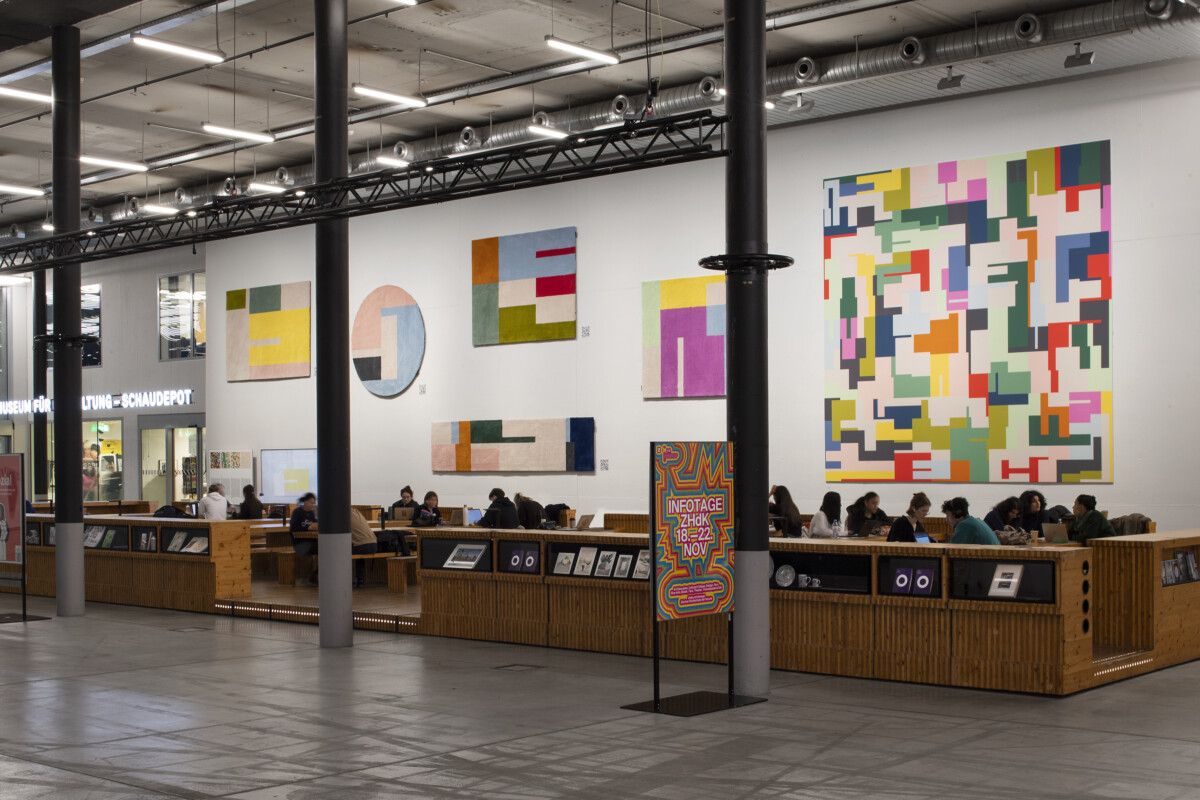
From November 2024 to January 2025, the Museum für Gestaltung Zürich presented five unique pieces from the Fellow Rugs collection. Developed by Stephan Hürlemann in collaboration with the Swiss manufacturer Ruckstuhl, the Fellows were part of a pilot project that explored questions of digitalisation, individualisation, and product circularity.
In the exhibition, the five wool rugs were accompanied by the original pattern matrix from which they had been cut, displayed on the wall. A screen showed the process of how a Fellow is made.
The Fellow collection consists of 75 unique rugs, each produced only after an order is placed. Using a digital template, a tufting robot creates each piece as a one-off without significant additional effort. Every rug represents a cropped section from one of five base matrices and is produced only once in one of six different shapes and proportions. The idea behind this approach is that individualisation fosters emotional value, creating personal companions — true Fellows — that stay with their owners for many years.
To support long-term and efficient use, each rug was given a digital identity. By scanning a QR code, visitors could access information on the rug’s origin, materials, production, care, repair, and recycling. An integrated digital diary
traced the rug’s individual journey. The digital Fellow also made resale simple, extending each piece’s lifecycle.
The digital identities were developed by the start-up World of Pi, co-founded by Stephan Hürlemann, whose aim is to help lead the furniture and design industry into the circular economy.


